Product Thinking vs Feature Factories: Why Most SaaS Products Fail
Vishal Anand
188 views · 5 min read
5 min read | 1 months ago
Why do most SaaS products fail despite shipping code faster than ever? The answer lies in the trap of the Feature Factory. Discover how to transition from shipping outputs to delivering high-impact user outcomes through the power of product thinking.
In the modern software landscape, shipping speed has become the ultimate vanity metric. Teams boast about deploying multiple times a day, maintaining 100% CI/CD uptime, and packing sprint backlogs with complex tickets. Yet, despite this breakneck velocity, over 90% of SaaS startups fail, and enterprise platforms regularly suffer from feature bloat that confuses users and dilutes product value.
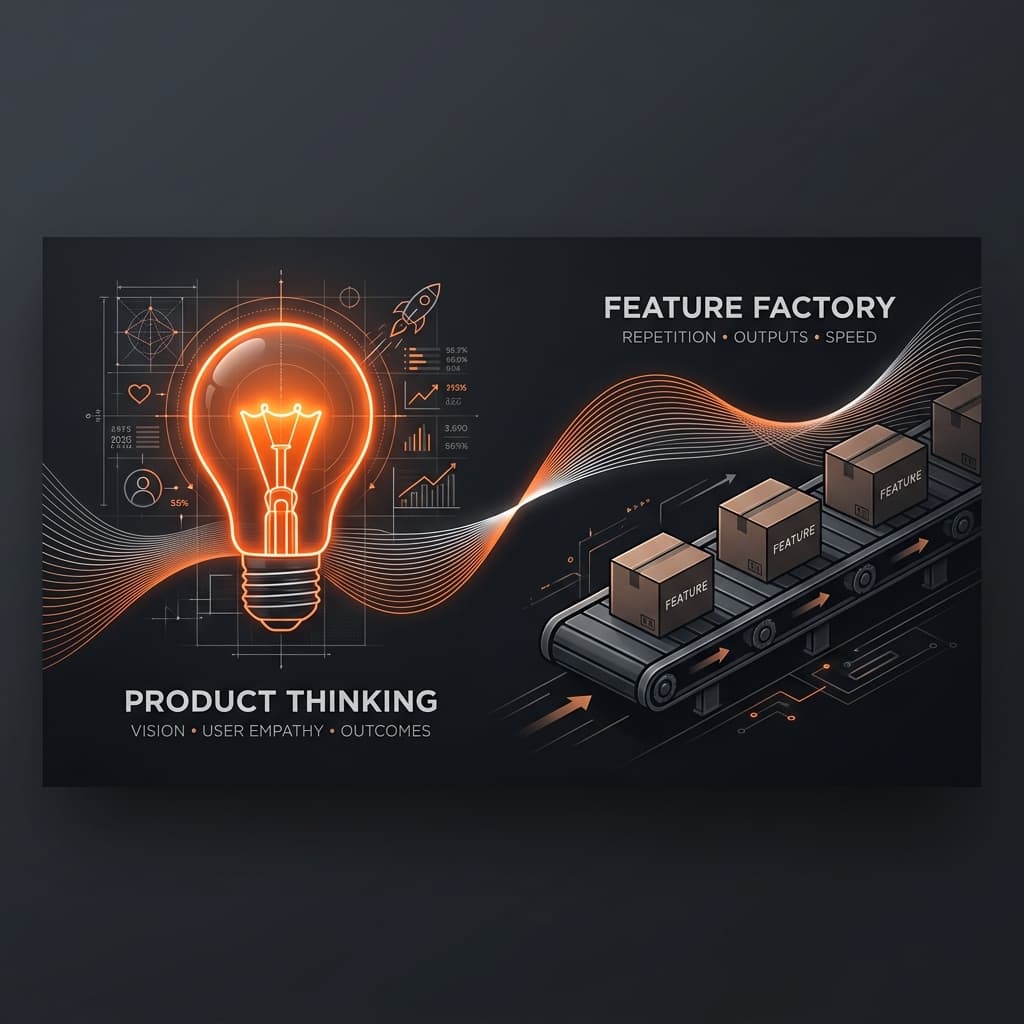
The reason for this paradox is simple: teams are stuck in a Feature Factory loop. They prioritize shipping outputs (building features) rather than driving actual outcomes (solving user problems). To survive and grow in 2026, SaaS companies must shift their culture from output-driven execution to outcome-driven product thinking for saas.
What is a Feature Factory?
The term "Feature Factory," coined by product expert John Cutler, describes a software development organization that measures success by the sheer volume of code shipped. In these environments, developers are treated as assembly line workers, product managers act as project administrators, and designers operate as beauticians who apply cosmetic layouts to pre-determined ideas.
"If you measure a team by how many features they build, they will build features. If you measure them by the business outcomes they unlock, they will build solutions."
The Warning Signs of a Feature Factory
How do you know if your SaaS company is trapped in this cycle? Look out for these critical red flags:
No Follow-Ups: Once a feature is deployed, the team immediately moves to the next ticket. No one measures user adoption, monitors drop-offs, or calculates ROI.
Velocity as the Primary KPI: Sprint retrospectives focus entirely on story points completed and burn-down charts rather than user satisfaction or activation rate metrics.
The Sales-Led Trap: Features are built solely because a single high-profile prospect promised to sign if a specific button was added, resulting in fragmented custom software instead of a cohesive product.
Low Customer Engagement: Despite a constantly growing feature list, active daily usage remains flat or declines, and customer churn rates continue to climb.
The Core of Product Thinking for SaaS
Product thinking for saas is the systematic approach to identifying user friction, validating market assumptions, and aligning engineering execution to business-critical goals. Instead of asking "What should we build next?" product thinking starts by asking "What user problem are we trying to solve, and why does it matter?"
Dimension | Feature Factory (Output) | Product Thinking (Outcome) |
|---|---|---|
Primary Goal | Ship features on schedule | Solve user problems & drive retention |
Metrics Defined | Velocity, code coverage, ticket count | Activation rate, churn, daily active usage (DAU) |
Designer's Role | Create high-fidelity mockups of specs | Co-lead discovery, map user journeys, run validation |
Roadmap Strategy | Linear list of pre-determined features | Theme-based, mapping problems to business values |
Why Feature Factories Lead to Product Failures
When SaaS platforms act as feature factories, they run into three systemic issues:
1. UX Complexity & Feature Bloat
Every feature you add introduces mental friction. Navigation bars expand, settings pages become labyrinths, and onboarding screens require long instructional videos. Users sign up to solve a singular problem quickly; if they have to navigate a cockpit of unnecessary features, they will churn and find a simpler micro-SaaS alternative.
2. Engineering & Technical Debt
Building features takes time, but maintaining them takes forever. In a feature factory, engineers rush to meet launch deadlines, skipping automated testing, modular architecture, and proper documentation. Over time, codebases become so fragile that introducing a simple change in one area breaks unrelated features, completely stalling future development.
3. High Opportunity Cost
Every hour your developers spend building a feature that users don't need is an hour they could have spent optimizing your core value proposition, improving page load speeds, or streamlining the sign-up funnel. You are burning money on features that nobody uses.
A 4-Step Framework to Escape the Feature Factory Loop
Transitioning a company's culture is hard, but it is the only way to build a high-performance product that users love. Here is a practical framework to guide the transition:
Step 1: Frame the Roadmap Around Problems, Not Solutions
Instead of writing "Build an AI-powered automated report builder," frame it as the underlying user problem:
User Problem: "Marketing managers spend 4 hours every Friday manually gathering performance metrics from three different dashboards to build reports for their clients."
This shifts the team's focus. Now, they aren't married to an expensive AI solution. They can test multiple lighter options—like a weekly scheduled PDF export or a simple automated Google Slides integration—to solve the user's problem.
Step 2: Dual-Track Agile (Discovery + Delivery)
Do not let developers build anything that has not been validated. Adopt a dual-track framework:
Discovery Track: Product managers, UX/UI designers, and tech leads conduct user interviews, build low-fidelity wireframes, run quick prototypes, and validate interest.
Delivery Track: Once a solution is proven to solve a real user problem, it moves to the delivery track where engineers build it with clean, scalable, production-grade code.
Step 3: Measure Product Outcomes Post-Ship
Create a strict rule: no feature is "done" until its impact is measured. When deploying a feature, set clear threshold metrics in your analytics suite (e.g., Mixpanel, Amplitude). Check back 14 days and 30 days after release. If the feature didn't move the target metric (e.g., activation rate didn't increase by 5%), gather qualitative feedback, iterate on the design, or boldly deprecate and delete it.
Step 4: Hire Partner Studios, Not Code Outsources
If you work with external agencies, do not hire typical outsourcing firms who blindly build specs without questions. Partner with agencies that challenge your assumptions, conduct competitive analysis, build information architectures, and write scalable frontend code designed around human behavior.
Looking to Build a High-Retention SaaS Product?
At UI Pirate, we don't just ship beautiful interfaces—we apply deep product thinking for saas to turn your ideas into shipped products that users actually love. From complex information architecture to robust React/Angular development, we help you launch fast and build right.
Book a Free 15-Min Strategy Session Explore Our Design & Dev Services
Personalized Help
Struggling with Product Thinking vs Feature Factories: Why Most SaaS Products Fail? Let's talk about your product.
UI Pirate is a product design & development agency trusted by 50+ SaaS founders and enterprise teams across the US, UK & beyond. Tell us what you need.
More to Read
All articles → conversational-ai
Designing NxVoy: Redefining the Flight Booking UX with Conversational AI
We designed a travel platform where users could say "Book a 3-day Dubai trip for 3 people" and actually get a bookable result — with flights, weather, visa info, and local tips — instead of a search form.
 case-study
Designing ConnectWise: How We Solved Complex Operations and Event Engagement in One Ecosystem
We designed two products for the same organization — an AI-powered support operations platform and an event networking app — and made them feel like one ecosystem.
 ux case study
Fixing a Broken Rental Lifecycle: A Multi-Product UX Case Study
How we designed StayPe, a connected four-product PropTech ecosystem unifying tenants, brokers, and landlords across the rental journey.