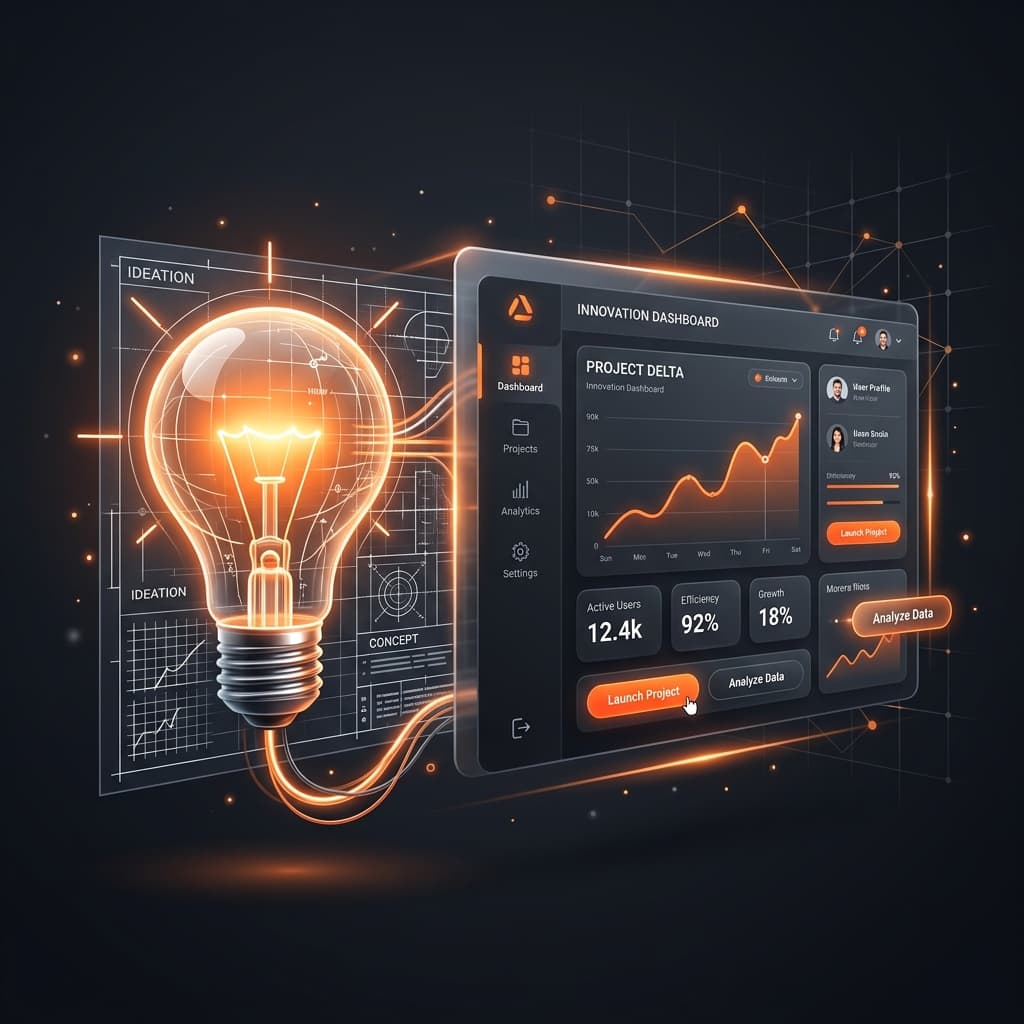
From Idea to Product: A Step-by-Step Guide for Non-Technical Founders
Vishal Anand
216 views · 6 min read
6 min read | 1 months ago
Moving from a raw business idea to a shipped, scalable digital product can be a black box for non-technical founders. This step-by-step pillar guide breaks down product thinking, wireframing, technical stacks, and choosing the right agency model to turn your vision into a successful product.
The Founder's Dilemma: Navigating the Product Black Box
You have a brilliant business idea. You've validated the market demand, spoken to potential customers, and perhaps even secured initial interest from investors. But there's a catch: you are a non-technical founder.
In the modern software landscape, turning a raw vision into a shipped, scalable product can feel like entering a black box. You hear terms like "agile development," "responsive viewports," "Docker images," and "NoSQL databases." It's easy to feel overwhelmed, and unfortunately, it's even easier to make costly mistakes that burn through your runway before you launch.
This comprehensive, step-by-step pillar guide is built specifically to lift the curtain. We will walk through the exact product lifecycle—from initial concept definition to selecting a technical stack and choosing the right execution partner—so you can confidently lead your startup from idea to product.
Phase 1: Refining Your Vision Through Product Thinking
The biggest trap for non-technical founders is jumping straight into hiring developers. Writing code is the most expensive way to validate an idea. Before a single line is written, you must refine your business hypothesis through the lens of product thinking.
"Product thinking is the act of solving real problems for real users with a viable business model. It's about finding the intersection between user desirability, technical feasibility, and business viability."
To establish this foundation, answer these three core questions:
What core problem are you solving? (Be incredibly specific. "Making accounting easier" is too broad. "Reducing manual expense entry for mid-sized logistics companies" is a targetable problem.)
Who is your primary user? (Create detailed personas. What is their daily routine? Where do they experience friction? What software do they already pay for?)
How will your product succeed where competitors fail? (Conduct a thorough competitive analysis. Don't copy features; identify gaps in information architecture, design systems, and workflow speed.)
Phase 2: Information Architecture & Wireframing
Once you've defined the core user flow, it's time to build the blueprint. This is where Information Architecture (IA) and **UI/UX Design** become your superpower.
Information Architecture is the structural map of your product. Think of it like organizing a library: where do users land, how do they find what they need, and what paths do they take to perform core actions?
1. Map the User Journey
Sketch a flow diagram showing the steps a user takes to complete their primary goal. For example, if you are building a SaaS booking app, the core flow might be:
Landing Page → Quick Registration → Dashboard → Click 'Create Event' → Set Availability → Generate Shareable Link.
2. Low-Fidelity Wireframes
Grab a notebook or a tool like Figma. Sketch the layout of your core screens. Do not worry about fonts, colors, or images. Focus exclusively on content placement and user controls:
Where does the header navigation go?
How are buttons aligned? (Hint: Keep primary actions prominent and styled consistently).
How do you structure data blocks? (e.g., sidebars for secondary options and central panels for main work areas).
By creating wireframes, you translate abstract thoughts into concrete product screens, which dramatically reduces communication friction when you eventually engage a design and development team.
Phase 3: Defining a Lean, Shipped MVP
A Minimum Viable Product (MVP) is not a subpar, poorly-designed application. Instead, it is **the thinnest possible slice of your product that delivers actual, standalone value** to your target audience.
Non-technical founders often fall victim to "feature creep"—wanting to build every possible feature on day one. To prevent this, categorize your roadmap using a prioritization framework:
Feature Category | Definition | MVP Status |
|---|---|---|
Core Pillar | The absolute reason your software exists. The product cannot function without it. | Yes (100% polished) |
Workflow Accelerator | Features that save time but aren't strictly mandatory (e.g., CSV imports, bulk edits). | Maybe (only if highly critical) |
Nice-to-Haves | Third-party integrations, advanced reporting, complex sharing tools. | No (postpone to v2.0) |
Remember: It is infinitely better to have a product that does one single thing exceptionally well and wows users, than an bloated application that does ten things poorly.
Phase 4: Deciding on a Technical Stack
You don't need to know how to write code, but you do need to understand the architectural pillars of your product. When selecting a tech stack, prioritize stability, developer availability, and future scalability.
React vs Angular for Complex Frontends
If you're building a highly interactive, enterprise-grade SaaS application, your frontend choices will typically come down to two heavyweights:
React (Next.js): Excellent for fast initial page load times, SEO-friendly applications (thanks to Server-Side Rendering), rich UI ecosystems, and rapid iterations. This website, UI Pirate, is built on Next.js 14 to leverage Edge rendering and super-fast page updates.
Angular: The powerhouse for massive, data-heavy enterprise dashboards. Angular provides a highly structured, strongly-typed framework (using TypeScript) that forces code consistency, making it a favorite for large enterprise engineering teams.
Backend and Database Architecture
Ensure your backend architecture is decoupled (using REST APIs or GraphQL). For startups, using robust, battle-tested solutions like **Node.js, Express, and MongoDB** (NoSQL for flexible data schemas) or **PostgreSQL** (SQL for strict transactional relationships) guarantees that your database won't buckle as your user base expands.
Phase 5: Choosing the Right Execution Partner
A non-technical founder is only as strong as their execution partner. You essentially have three routes for building your product:
1. Freelancers
Often the cheapest upfront, but highly risky. Freelancers excel at small, isolated tasks but rarely possess the holistic product thinking, UX research depth, and architectural foresight needed to construct a complete SaaS product from scratch.
2. Offshore Feature Factories
Agencies that write code exactly to your specifications. The problem? If your specifications have a logical flaw (which they almost always do in early stages), they will build it anyway. You get exactly what you asked for, not what your users actually need.
3. Specialized Product Design & Development Studios
An integrated team (like UI Pirate) that acts as your co-founders. They don't just take orders; they engage in competitive audits, optimize your information architecture, craft premium interactive design systems, and build robust, high-performance web applications using modern tech stacks.
When selecting a product studio, look for one that values **visual excellence, clear communication, and end-to-end responsibility**—shaping your raw business ideas into beautiful, finished products ready to capture active market share.
The Road Ahead: Building Your Legacy
Moving from an idea to a fully shipped, high-conversion product is a journey of refinement. By prioritizing user validation, leveraging proper information architecture, mapping a lean MVP, and partnering with an execution team that respects the intersection of business strategy and high-fidelity code, you can build software that stands out and delivers incredible value.
Are you a non-technical founder looking to ship your startup product or SaaS app? Let's turn your vision into a premium, custom digital reality. Get in touch with UI Pirate today.
Personalized Help
Struggling with From Idea to Product: A Step-by-Step Guide for Non-Technical Founders? Let's talk about your product.
UI Pirate is a product design & development agency trusted by 50+ SaaS founders and enterprise teams across the US, UK & beyond. Tell us what you need.
More to Read
All articles → conversational-ai
Designing NxVoy: Redefining the Flight Booking UX with Conversational AI
We designed a travel platform where users could say "Book a 3-day Dubai trip for 3 people" and actually get a bookable result — with flights, weather, visa info, and local tips — instead of a search form.
 case-study
Designing ConnectWise: How We Solved Complex Operations and Event Engagement in One Ecosystem
We designed two products for the same organization — an AI-powered support operations platform and an event networking app — and made them feel like one ecosystem.
 ux case study
Fixing a Broken Rental Lifecycle: A Multi-Product UX Case Study
How we designed StayPe, a connected four-product PropTech ecosystem unifying tenants, brokers, and landlords across the rental journey.